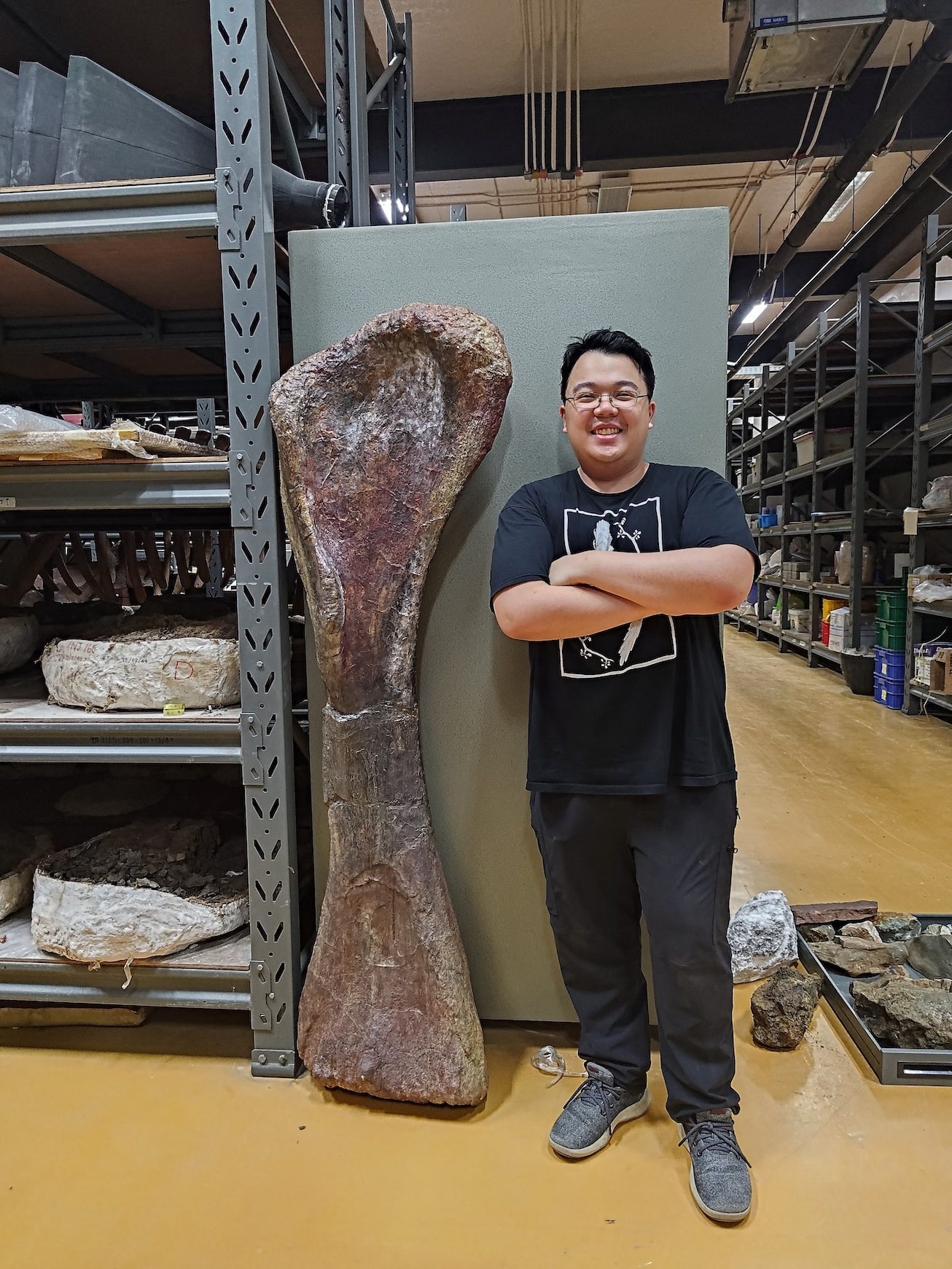
Nagatitan supplies perception into sauropod variety within the area. Not many sauropods are recognized from Southeast Asia, and Nagatitan is the biggest and the geologically youngest of them.
Alongside a meandering river in a heat and arid area that’s now Thailandroughly 113 million years in the past, a plant-eating behemoth virtually 90 toes (27 meters) lengthy browsed on the treetops with out a lot worry of predators as a consequence of its sheer dimension. This was Nagatitan chaiyaphumensis, the largest-known dinosaur from Southeast Asia.
Researchers have unearthed skeletal stays of Nagatitan, a member of the dinosaur lineage known as sauropods recognized for having an extended neck, lengthy tail, small head, and 4 columnar legs.
The fossils of this Cretaceous Interval dinosaur have been first noticed by a villager in Thailand’s northeastern province of Chaiyaphum. Scientists over a interval of years then dug up backbone, rib, pelvis, and leg bones, together with a entrance leg bone — the humerus — measuring 5.8 toes (1.78 meters) lengthy.
Primarily based on the scale of its humerus and femur, the corresponding hind leg bone, the researchers estimated Nagatitan’s physique mass at 25 to twenty-eight tons. Its head and enamel weren’t among the many fossils recovered, however the researchers have a good suggestion of its feeding preferences based mostly on different sauropods.
“Nagatitan was most likely a bulk browser that targeted on consuming excessive volumes of vegetation that required little to no chewing, resembling conifers and probably seed ferns,” stated Thitiwoot Sethapanichsakul, a College School London doctoral pupil in palaeontology and lead writer of the analysis revealed on Thursday, Could 14, within the journal Scientific Stories.
The local weather was most likely subtropical, with some forests, but additionally savanna-like and shrubland habitats. Nagatitan lived alongside varied different dinosaurs in addition to flying reptiles known as pterosaurs. The rivers have been teeming with crocodiles and fish, together with freshwater sharks.
The ecosystem’s largest predator was a relative of the enormous African meat-eating dinosaur Carcharodontosaurus, most likely about 26 toes (8 meters) lengthy and round 3.5 tons.
“At that dimension, it was dwarfed by Nagatitan. At full dimension, Nagatitan seemingly had little or no to worry when it comes to predation,” Sethapanichsakul stated.
Predators most likely averted attacking wholesome adults of any massive sauropod species due to the hazard of being squashed. However they might have focused previous or sick adults or susceptible infants.
“Certainly, sauropods are recognized to have grown in a short time after hatching, and this most likely pertains to the hazards of predation. The earlier sauropods might change into massive, the safer they have been as a result of they might have been tougher to deal with,” College School London paleontologist and research co-author Paul Upchurch stated.
Sauropods included the biggest land animals in Earth’s historical past. Nagatitan was enormous by any normal, however not on the size of some South American sauropods resembling Argentinosaurus and Patagotitan that topped 100 toes (30 meters) lengthy.
Nagatitan’s title references Naga, a serpent-like being in some Asian non secular traditions that’s prominently depicted in varied Thai temples. In all, there are 14 named dinosaurs recognized from Thailand.
The names of a number of massive sauropods embody the phrase titan. Sethapanichsakul stated it could be acceptable to name Nagatitan Southeast Asia’s final “titan” as a result of the area turned a shallow sea later within the Cretaceous, that means no extra sauropods would dwell there.
Nagatitan supplies perception into sauropod variety within the area. Not many sauropods are recognized from Southeast Asia, and Nagatitan is the biggest and the geologically youngest of them. Nagatitan belonged to a subgroup of sauropods that possessed bones with a number of inner air sacs and skinny partitions, traits that lightened their skeletons.
This group originated round 140 million years in the past, achieved a worldwide distribution, and, round 90 million years in the past, turned the one sauropods left worldwide, thriving till the dinosaur age ended 66 million years in the past with an asteroid impression.
Nagatitan lived at a time when Earth’s atmospheric carbon dioxide ranges have been climbing, comparable to excessive international temperatures.
“Sauropods appear to have change into notably massive right now, with gigantic kinds dwelling in South America, China, most likely North Africa, and now with Nagatitan, a reasonably large one in Southeast Asia,” Upchurch stated.
“This doable relationship between massive physique dimension and excessive climatic temperatures is just not totally understood, nevertheless it’s seemingly that the excessive temperatures had an impression on the plant fodder that was necessary to sauropods, which have been very large-bodied herbivores. Nagatitan offers a glimpse of the interval main as much as the eventual peak in physique dimension and temperatures about 10 to fifteen million years later,” Upchurch stated. – Rappler.com
https://weblog.passive-income4u.com/create-your-very-own-auto-publish-news-blog-site-and-earn-passive-income-in-just-4-easy-steps/
https://www.rappler.com/science/earth-space/scientists-dig-up-southeast-asia-largest-dinosaur-thailand/