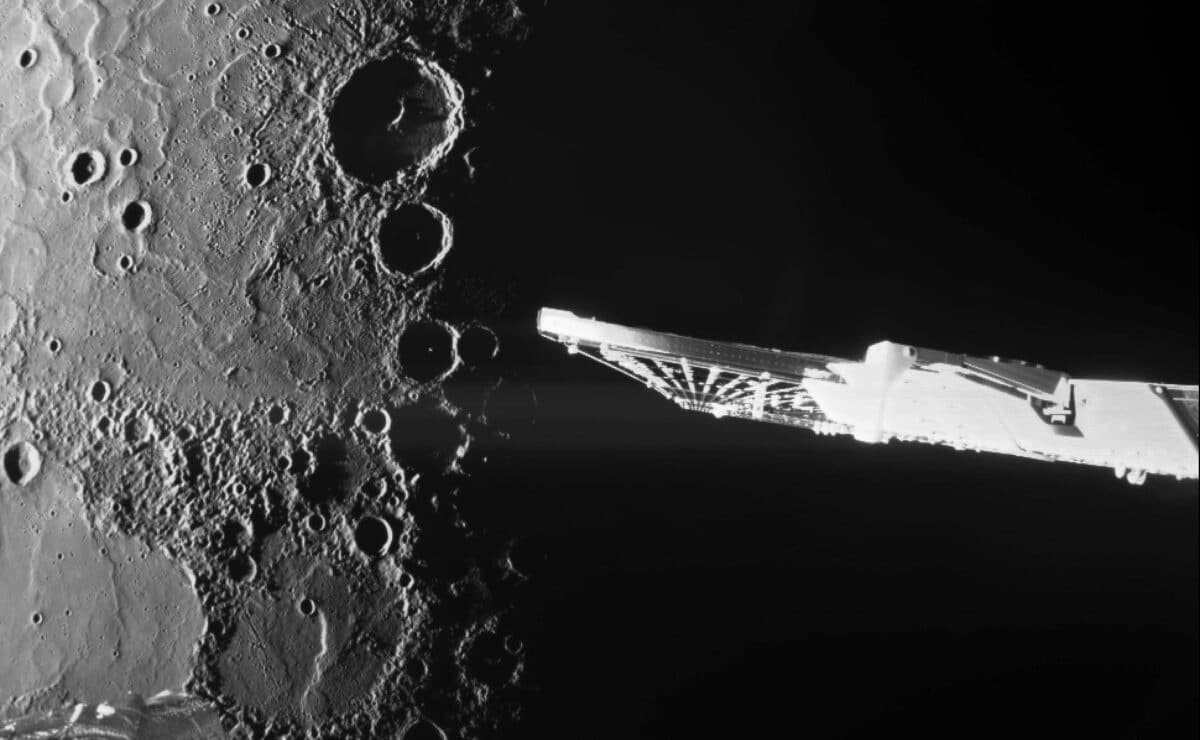
CAPE CANAVERAL, Fla. — Two Mercury-bound spacecraft left their mom ship behind on Thursday and headed down the house stretch of their almost decade-long voyage to the photo voltaic system’s smallest and closest-to-the-sun planet.
The linked European and Japanese spacecraft separated as deliberate from their cruiser, however controllers needed to wait two anxious hours to obtain affirmation through radio indicators. The essential operation was broadcast from the European Area Company’s management middle in Germany, greater than 124 million miles (200 million kilometers) away.
“It’s an excellent second,” stated lead undertaking scientist Geraint Jones.
If all goes effectively, the conjoined spacecraft referred to as BepiColombo will enter orbit round Mercury in November and break up from one another in December to map and research the complete planet from totally different altitudes. As of Thursday, the spacecraft nonetheless had 2 million miles (3.3 million kilometers) to go earlier than reaching its vacation spot.
READ: ‘Very strong,’ El Niño to last until February, UN warns
Italian mathematician
Launched in 2018, the BepiColombo mission is called for the Italian mathematician who took half in NASA’s Mariner 10 mission to Mercury within the Seventies. Just one different spacecraft, NASA’s Messenger, has explored the puzzling, scorching planet that’s just a bit greater than our moon.
“How tiny Mercury is and nonetheless it holds a number of the greatest mysteries of our photo voltaic system,” mission supervisor Santa Martinez stated earlier this week.
Added Jones: “There’s an enormous quantity nonetheless left to be realized.”
BepiColombo already has traveled greater than 6 billion miles (10 billion kilometers) on its roundabout route, in response to Martinez.
It wanted 9 planetary flybys to cut back its vitality sufficient to be caught in Mercury’s orbit. The final flyby, in January 2025, yielded gorgeous photographs of Mercury’s influence craters and volcanic plains.
READ: Make your astronaut dream come true: Here’s how
Research subsequent spring
Starting subsequent spring, a slew of science devices on the European and Japanese spacecraft will research the magnetic area that envelops Mercury, the planet’s dense inside, and the geologic processes on the floor, together with the hollows, or depressions, that scientists consider are being eaten away by minerals vaporizing from rocks.
It’s an odd world of contrasts. On a planet the place the temperature can high 800 levels Fahrenheit (427 levels Celsius), the poles are frigid with deep, completely shadowed craters filled with ice.
Given Mercury’s proximity to the solar, engineers needed to design the spacecraft to face up to “extraordinarily punishing” situations, stated the European Area Company’s Ignacio Tanco, a mission operations chief.
“It’s primarily equal to working with a highly regarded pizza oven working proper in your again,” he stated.
Science observations ought to start subsequent spring, with the European Area Company overlaying a lot of the mission’s $2 billion (1.7 billion euros) price.
Learn Subsequent
Disclaimer: The feedback uploaded on this website don’t essentially characterize or replicate the views of administration and proprietor of Cebudailynews. We reserve the suitable to exclude feedback that we deem to be inconsistent with our editorial requirements.
https://weblog.passive-income4u.com/create-your-very-own-auto-publish-news-blog-site-and-earn-passive-income-in-just-4-easy-steps/
https://cebudailynews.inquirer.internet/763924/spacecraft-closer-to-mercury-after-nearly-decade-long-voyage