BATANGAS, Philippines – In entrance of a home alongside the mangrove coast in Calatagan, Batangas, rafts and boats sat moored.
Jessie delos Reyes, 50, a slight-framed man who has lived on this home all his life, calls these rafts his floating lecture rooms; for greater than half his life, he has dived out and in of the waters of the marine reserve just some minutes away from his home.
He is named Kuya Jessie of the floating homes in Calatagan. His title is acquainted to locals, vacationers, college students, and marine scientists who come right here for fieldwork and retreat.
The climate was truthful that Tuesday morning in November. I joined Jessie on one in all his dives to test the corals in Buntong Gasang, a coral monitoring website. The spot is a couple of minutes off the coast and never that deep. Buntong Gasang is adjoining to the Verde Island Passagethe well-known waterway on the coronary heart of the world’s Coral Triangle.
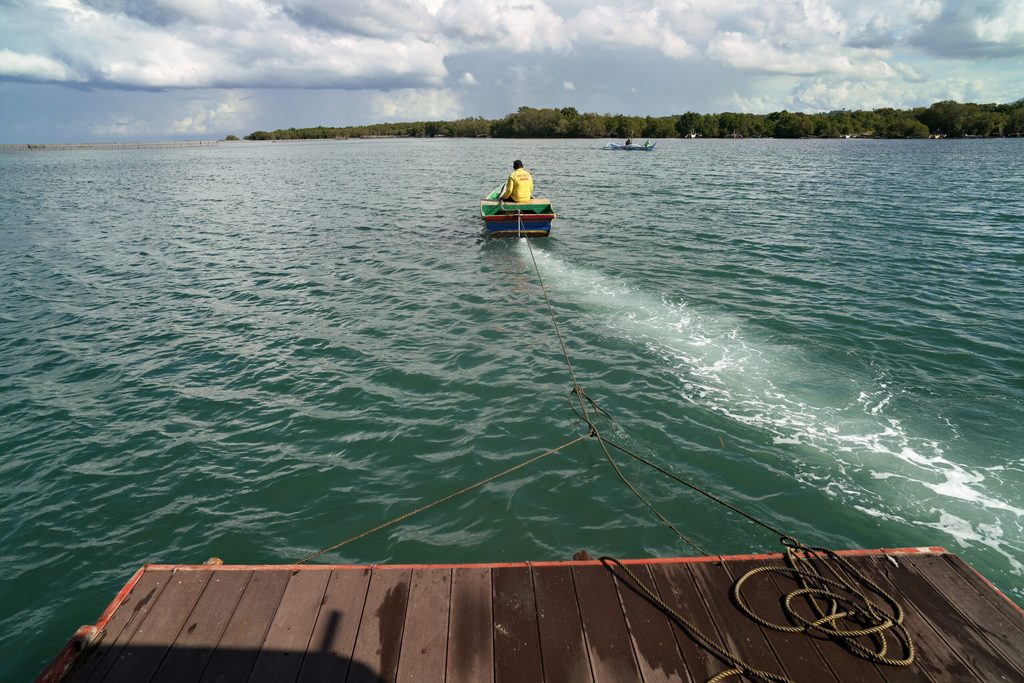
We used the floating classroom to go to Buntong Gasang. A motorized boat pulled the raft from the coast.
Three extra divers made up Jessie’s crew that morning — males who make a dwelling instructing water security expertise, divers for nongovernmental organizations. That Tuesday, they had been all volunteer divers for Calatagan Reef Patrollers or Carepas, which Jessie based in 2004.
On the floating classroom, they moved relaxed with their scuba diving tools. On the desk was a inexperienced thermos stuffed to the brim with espresso baro (barako espresso) and bread for a fast breakfast.
They used a laminated coral well being chart — composed of a number of shades of coral colours — from Australia’s College of Queensland. Divers maintain this chart towards the corals to match colours and grade them correctly.
When it turns 1 — or the palest shade of every coloration — it means the coral has bleached. As soon as they’ve recognized the proper shade of the coral with the chart, they write the grade on their slates. They submit these stories to authorities and consultants.
Throughout the dive, Jessie delegated duties to the crew. The protection diver entered the water first to test the present. Jessie laid the transect and picked up knowledge, with one other diver tailing him to help. Then one other diver took pictures and movies.
About half-hour later, after surfacing from the water, Jessie mentioned there was excellent news and dangerous information. The excellent news: a number of the corals that had been bleaching a month in the past confirmed indicators of restoration.
“However the dangerous information is most of them had been not too long ago killed,” Jessie mentioned after the dive. “There’s algae already. They weren’t in a position to get better.”
After a few years of monitoring the corals in Calatagan, Jessie has develop into an advocate for “citizen science,” the place group members work alongside scientists to observe adjustments within the marine surroundings.
“The marine biologists, marine scientists, come and go,” Jessie mentioned. “The group, even when their eyes are closed, even once they’re asleep, they know what’s taking place locally.”

The promise of citizen science
Coral scientist Wilfredo Licuanan has at all times dreamed of municipal fisherfolk checking the well being of corals and reefs all on their very own.
Licuanan, known as Al by household and colleagues, is a De La Salle College professor who makes a speciality of coral reefs. He established the SHORE Middle, La Salle’s analysis middle that pioneered a citizen science program on coral reef monitoring.
Al, 63, grew up in Diliman, Quezon Metropolis — the third era of their household to check at College of the Philippines (UP). He took up marine science as an undergraduate, solely studying to swim the summer time earlier than his first semester, earlier than later shifting to zoology.
On the former Marine Science Middle (now Marine Science Institute) at UP, he was a analysis assistant to the inimitable Edgardo Gomez, the middle’s founding director. He ultimately left the middle and joined the La Salle college in 1997.
The subsequent 12 months, he began to handle the college’s Br. Alfred Shields FSC Marine Station in Lian, Batangas. The marine station lies within the western a part of Lian, going through the Verde Island Passage and the West Philippine Sea. Its location is accessible to divers within the province, together with volunteers from neighboring Calatagan.
Al mentioned he has spent most of his time on the marine station as a lot as he might. Again then, it was nonetheless plain and naked, constructed like a bunkhouse alongside the coast within the distant a part of city.
From 2014 to 2017, Al and his crew at La Salle’s marine middle surveyed reefs for a nationwide evaluation. The sheer scale of the work led them to develop additional strategies non-scientists might additionally use to evaluate coral communities and native reefs.
This ultimately grew to become the Alwan methodology. Alwana Tagalog phrase that means “to ease,” advanced from the work of native and overseas researchers: a person is educated to determine butterflyfish and goal marine invertebrates and corals at a particular survey station.
By the top of this system, trainees are anticipated to know how you can safely conduct a survey on their very own, determine goal species to find out reef well being, and monitor bleaching triggered by local weather change.

Forty years in the past, when Al began his coral research, he didn’t intentionally got down to promote citizen science.
There usually are not sufficient scientists, and it might be inconceivable to commonly test on reef well being with out the assistance of people who find themselves most regularly at sea: the fishermen, sea patrol, locals, lifeguards, and even leisure divers.
“These strategies had been truly an early type of citizen science within the sense that they had been developed in Australia in order that individuals who can dive however don’t essentially have the science coaching (can) do surveys within the Nice Barrier Reef,” Al mentioned.
On the sphere
A couple of weeks after my Calatagan go to with Jessie’s crew, I joined Al and his SHORE Middle workers in La Salle’s marine station in Lian. That they had began coaching folks from the Bureau of Fisheries and Aquatic Assets (BFAR) on how you can monitor reefs.
It was one other Tuesday morning at sea. The water was chilly, and I used to be swimming towards the reef crest in entrance of the marine station, following Al towards a jutting rock. He moved deftly within the acquainted waters, whereas I attempted to maintain up.
As we swam, the seafloor seen beneath me began to fade, and all I might see was blue. A couple of moments later, a blanket of useless staghorn corals appeared. I knew they had been useless due to the fuzzy texture. Algae had grown and brought over.
Above water, Al informed me that amid the useless staghorn corals, there have been new, dwelling ones.
“I’ll level them to you,” he informed me. We swam a bit extra, and the stay staghorn corals had been laborious to overlook. Staghorn corals have branches, and these had white suggestions.
Al later informed me that meant they had been nonetheless rising. I requested him how there could possibly be dwelling ones among the many useless. It’s the present, Al mentioned. Corals could also be spawning in one other a part of the reef, or in one other reef altogether, and the coral eggs and sperm made it to the realm because of the present.

A couple of minutes later, the BFAR workers who simply completed water security drills caught up with us on the reef. This was the primary session of SHORE’s coaching for the BFAR. Amongst this session’s members had been the Carepas volunteer divers I visited in Calatagan weeks earlier than.
Local weather disaster and the decline of native reefs
By means of the coral reef evaluation from 2014 to 2017, Al and his crew found a “marked decline” within the situation of native reefs prior to now 4 many years (because the first evaluation was carried out from 1976 to 1981).
Lots of their evaluation stations had been in Luzon, particularly within the Verde Island Passage. The marked decline in situations led the crew to report then that “the institution of marine protected areas, and different interventions prior to now 40 years haven’t brought on an considerable impression on general reef situation generally, besides particularly localities.”
“Largely, it’s local weather change,” Al mentioned in an interview earlier than their fieldwork in Lian.
“I maintain saying it’s essentially the most seen manifestation of local weather change,” he added. “As a result of when the water is sizzling, that isn’t a localized occasion. It occurs in massive sections of the ocean.”

The world is already on track to exceed the 1.5 degree Celsius limit that international locations set to keep away from the intense impacts of local weather change. At this level, drastic steps ought to already be taken to chop down greenhouse fuel emissions.
Sustaining ocean well being by defending coral reefs, mangroves, and seagrasses may also help lower down emissions. Australia and Turkey, co-presidents of this year’s largest climate summitput the ocean on the coronary heart of the convention, but the talks broke down after a remaining draft deal failed to say fossil fuels.
A lifestyle
Again in Calatagan, the coast reverse Jessie’s home was lined with mangroves.
“We planted these mangroves on September 2, 2002,” he informed me after that morning’s coral monitoring session. “We have now mangroves, we now have seagrass, we now have corals. The ecosystem right here is full.”
Jessie grew up in Calatagan. His dad and mom fished for a dwelling, and Jessie himself was a fisherman earlier than he grew to become a part of the ocean patrol, grew to become a lifeguard, realized to dive, and ultimately based his volunteer divers’ group.


Greater than 20 years in the past, he attended a course that Al used to show: marine biology for non-biologists. (“I taught it on the weekends,” Al informed me in a separate interview. “Jessie was within the class.”)
Jessie has already seen all of it: corals bleaching and recovering, the devastating impression of El Niño occasions in current historical past, and typhoons that wreak havoc underwater.
His want to guard the ocean is one thing he could have inherited from his dad and mom, Jessie mentioned
— from fisherfolk who had been at sea daily and who noticed what a wholesome ocean appeared like and what it might give them. – Rappler.com
Quotes translated to English for brevity.
This story was produced with the assist of Informed Earth as a part of the COP31 Ocean Digital Reporting Fellowship.
https://weblog.passive-income4u.com/create-your-very-own-auto-publish-news-blog-site-and-earn-passive-income-in-just-4-easy-steps/
https://www.rappler.com/surroundings/coral-reef-watchers-saving-ocean/