DAVAO CITY (MindaNews / 9 April) — To observe When Birds Can’t Fly is to enter a room already divided in opposition to itself.
The movie opens within the bed room, an area directly intimate and surveilled. Shela friends out a window from behind translucent curtains — already half-seen, half-hidden — earlier than the movie teaches us look: with a watch skilled not on the fullness of the physique, however on its discount.
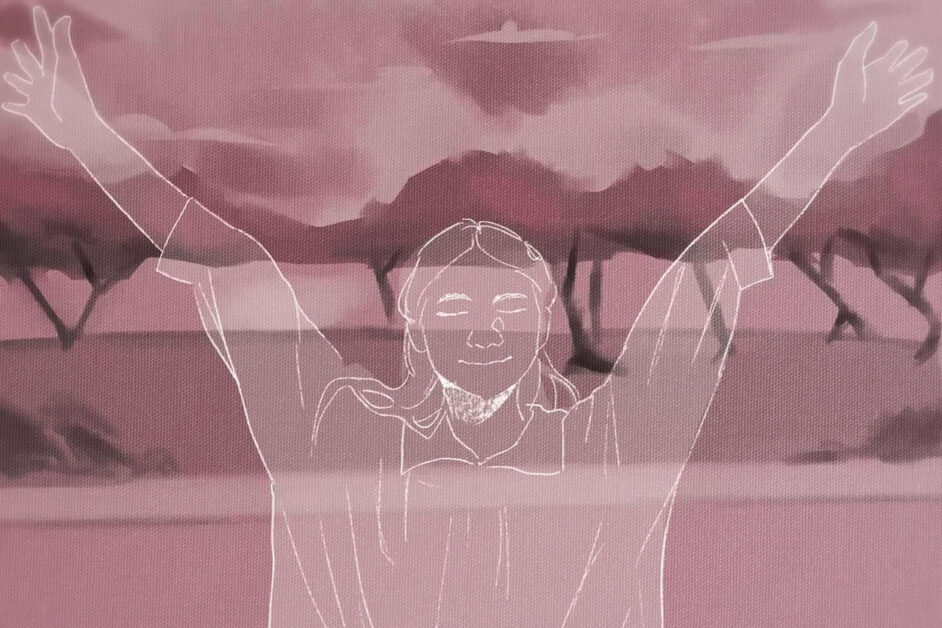
Shela seems first as a ghost, then as a top level view — a white, monoline determine, translucent, nearly erasable — earlier than she is allowed to seem as an individual.
Within the work of incapacity research scholar Rosemarie Garland-Thomson, the stare is “an embodied and relational visible alternate that carries advanced cultural and historic meanings … drenched with significances, scrupulously regulated, and intricately ritualized” — a structuring pressure that produces the unusual, the surprising, the unfamiliar, as spectacle. As modernity developed, Thomson writes, “establishments lassoed human curiosity by ritualizing the urge to stare on the surprising.” On this mild, the disabled physique turns into one thing to be checked out, mounted, interpreted, contained.
Bea Allado’s intervention is refined however exact: moderately than eradicating the gaze, she dulls its pressure. By rendering Shela as a translucent line drawing, the movie positions her between visibility and disappearance. She is seen, however not absolutely graspable. She evades the violence of the stare, however at the price of opacity, slowly slipping into erasure.
The animated world, the place Shela runs freely throughout huge pink and purple expanses, initially seems as liberation. Right here, she is cellular, unbounded, joyous. The guitar soundtrack swells because the white noise of the true world dissolves. I discover myself tempted to learn this as escape; a utopian elsewhere the place incapacity not entraps.
However whereas the area is huge, additionally it is empty. There aren’t any “others” right here. Freedom, on this world, appears indistinguishable from solitude.
Incapacity research has lengthy critiqued narratives that body incapacity as one thing to transcend or overcome. In Feminist, Queer, Crip (2013), Alison Kafer argues in opposition to what she calls “healing time”: a body that “casts disabled folks (as) out of time, or as obstacles to the arc of progress” and inside which “the one applicable disabled thoughts/physique is one cured or transferring towards treatment” (28). The fantasy of strolling once more, of operating once more, of flying, usually falls into this narrative entice: it reaffirms that the disabled current is inadequate.
Beneath neoliberalism, the place time is calibrated to productiveness, and self-worth to self-sufficiency, this healing imaginary turns into a requirement, an obligation. The disabled physique is rendered legible solely insofar as it will possibly “return” to movement: into work, into progress, into usefulness.
Allado’s movie brushes in opposition to this imaginary earlier than quietly dismantling it: Shela’s animated physique can run, nevertheless it can’t be touched; Shela can transfer, however she can’t be accompanied.
A knocking on the door interrupts this fantasy with a pressure that’s auditory moderately than visible. The place dialogue within the movie is rendered as disembodied textual content that carries the burden of familial anxiousness — That is why I at all times say to you, you possibly can’t do it! You solely have one youngster, you might be simply letting it go. How is the way forward for Shela? — the knock insists upon sound, presence, intrusion. It’s the sound of an Different.
The movie makes use of silent-film textual content to render household dialogue. Stripped of voice, these strains turn out to be archival: mounted, unanswerable.
How about future is shela What’s going to turn out to be of Shela?
This query constructions disabled life beneath neoliberalism: a future measured in productiveness, independence, self-sufficiency; a future that usually can not think about disabled life as something besides lack. It’s a query the movie refuses to reply.
The place the animated world presents freedom with out others, the knock presents an different with out freedom. Neither is sufficient. Neither is adequate.
What emerges as an alternative is a sort of third area, a liminal zone the place animation and actuality start to break down into each other. The pink hues of the imagined world seep into the bed room; the bed room turns into traversable; a door seems inside a door.
Somewhat than selecting between actuality (constraint) and creativeness (escape), When Birds Can’t Fly constructs what we would name a crip area: an area that doesn’t demand the erasure of incapacity, however reconfigures the phrases of inhabiting it.
This aligns with Kafer’s notion of crip futurity: an accessible future moderately than a healing one; an elsewhere — or an “elsewhen” — the place incapacity is known as “political, precious, integral” (Kafer 3).
The movie’s visible language sounds this argument materially. The curtains — white, translucent — mirror Shela’s animated physique. The boundary between internal and outer worlds just isn’t mounted however porous. Her creativeness just isn’t a complete escape from actuality, however is already formed by it.
The query, for me, then, strikes from “How can we escape this physique?” to “How can we inhabit it, collectively?”
The movie’s central picture — the injured chicken — dangers the acquainted symbolic entice. The chicken flies; Shela can not. However when Shela lastly reaches the ocean, the true world begins to reflect the imagined portray.
Right here, we don’t mourn what she can not do. We’re as an alternative made to take care of what she does do: she goes exterior, she arrives on the sea, she participates within the ritual. The movie shifts the situations of worth from mobility to relation, from flight to presence.
The chicken’s flight just isn’t hers. However the act of holding it, of caring for it, of letting it go, is.
The movie brings this to a head with its closing parting phrases: He flies one other means — will you fly with him? She’s going to fly in one other means. Will you fly along with her?
To “fly in any other case” is to reject the ableist equation of freedom with mobility. It’s to rediscover motion — from neoliberal independence to interdependence. It’s to think about futures the place we not want to hide our elementary reliance on each other to outlive: Will you fly along with her?
On this mild, the sooner knock on the door — that which as soon as disrupted Shela’s imagined freedom — now turns into an invite: to open the door, to let others in, to construct a world the place one needn’t flirt with disappearance in pursuit of freedom.
The thinker Jean-Paul Sartre as soon as famously claimed that “Hell is different folks.” However beneath these situations of alienation and precarity, widespread financial instability, and neoliberal abandonment, what saves us would possibly lie exactly within the presence of others — within the messy, imperfect, but needed work of being with.
By collapsing the space between creativeness and actuality, visibility and opacity, solitude and companionship, limitation and risk, When Birds Can’t Fly opens us to futures which are neither utopian nor healing, however ones imagined within the in-between, the place our bodies aren’t erased to be able to belong. (Bea Gatmaytan / MindaNews)
Works cited:
Garland-Thomson, Rosemarie. “Staring on the Different.” Incapacity Research Quarterlyvol. 25, no. 4, 2005.
Kafer, Alison. Feminist, Queer, Crip. Indiana College Press, 2013.
https://weblog.passive-income4u.com/create-your-very-own-auto-publish-news-blog-site-and-earn-passive-income-in-just-4-easy-steps/
https://mindanews.com/arts-culture/2026/04/review-to-fly-otherwise-crip-futurity-and-the-refusal-of-disappearance-in-when-birds-cant-fly/