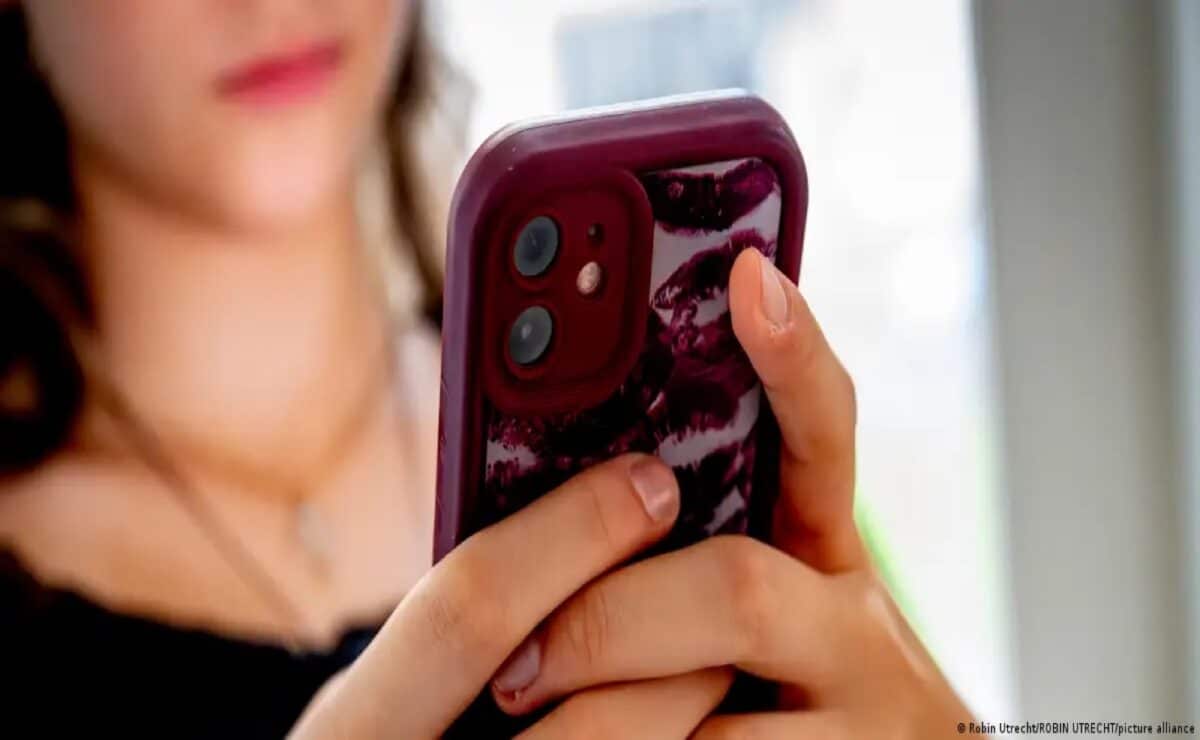

The web isn’t a secure place for unsupervised kids and younger folks — by now, that’s frequent information.
Social media platforms are adept at tweaking their algorithms to make sure customers of any age stay on their websites. To do this, they usually disseminate content material that may be harmful and upsetting for younger folks.
Research frequently discover a connection between what’s often called doomscrolling and a better threat of psychological issues within the younger, together with suicidal ideas. And a few of the newest tendencies in video creation on platforms like TikTok straight endanger the security of customers.
In the USA, Meta, which owns each Instagram and Fb, lately opted to settle a case in opposition to it out of court docket. Numerous US states had claimed that the 2 platforms harmed kids.
READ: A survivor’s fight against online sexual abuse
Meta agreed to pay as much as $17.1 billion (€14.7 billion) to the states concerned and to restrict youngsters’ entry to its platforms to only two hours a day. Throughout the evening, entry shall be fully blocked.
A brand new survey by UNICEF, the UN company for kids, places the highlight on one other hazard that younger folks always face within the digital world: sexual assault, a risk skilled by one in 5 folks between the ages of 12 and 17 over the previous 12 months.
What are the important thing findings?
The UNICEF report, which DW noticed upfront of publication, explains how such assaults usually occur.
“It usually begins with out warning,” the authors of the research wrote. “Dialog turns into coercion, and coercion turns into entrapment.”
The survey discovered that greater than 15 million kids had been uncovered to undesirable sexual content material. An estimated 9 million have been pressured into sexual conversations or requested to share sexual photographs, whereas some 4 million had sexual photographs shared with out their consent. The report’s authors, nonetheless, warn that the true scale is probably going far larger.
“The report reveals a painful actuality,” mentioned UNICEF Govt Director Catherine Russell. “These experiences trigger profound emotional and psychological misery. Many kids endure in silence, not sure the place to show for assist.”
Typically, the perpetrator of the assault places strain on a sufferer. The victims then really feel ashamed and this makes it tough to inform anyone about what has occurred. Of these surveyed, 41% had by no means informed anyone about their assault. Others mentioned that they had first confided in buddies, siblings or their moms. Fewer than 1% have been reported to authorities.
READ: Online sexual abuse of kids rising; better rescue, rehab measures pushed

The stereotype many have of a whole stranger harassing younger folks on-line truly solely applies in 16% of circumstances. Most perpetrators — 57% — are already recognized to their victims. They might be buddies, relations and even romantic companions.
As well as, 27% of respondents weren’t capable of establish the folks behind the profiles. When perpetrators are recognized, they embrace adults but in addition minors. In lots of circumstances, assaults happen in actual life in addition to on-line.
The key social media platforms are additionally the principle gateways for this sort of habits. The UNICEF report says 60% of assaults come primarily from Fb, WhatsApp and Instagram (all of that are owned by Meta), adopted by Snapchat, TikTok and YouTube. And 14% of respondents cited on-line gaming platforms as the situation of an assault — gaming platforms often have direct messaging channels.
How was the information collected?
The report polled round 21,000 younger folks in 21 international locations, aged between 12 and 17, who frequently use the web. Information from 12 international locations — Ethiopia, Indonesia, Cambodia, Kenya, Malaysia, Mozambique, Namibia, the Philippines, Tanzania, Thailand, Uganda and Vietnam — had already been collected in 2020 and 2021 and analyzed in an earlier report.
For this new report, extra information was collected in Armenia, Brazil, Colombia, the Dominican Republic, Mexico, Montenegro, North Macedonia, Pakistan and Serbia. The surveys have been additionally supplemented by longer interviews with 100 younger individuals who had skilled abuse.

Europe, US surveys discover comparable outcomes
Researchers acquainted with this difficulty wouldn’t be shocked by the size of the issue.
The 2020 EU Youngsters On-line Survey, primarily based on a ballot carried out in 19 European international locations, indicated that 22% of all individuals had obtained sexually specific messages on-line.
READ: Study: Kids know where, how to report online abuse—but don’t
In a Spanish research carried out in seven secondary faculties in 2021 and 2022, 21% of feminine respondents mentioned they have been sexually harassed on-line “sometimes,” whereas 5% mentioned this occurred “regularly.” For male respondents within the Spanish research, the odds have been a number of factors decrease.
The same survey carried out by the Pew Analysis Heart in 2022 discovered that 17% of 13- to 17-year-olds within the US mentioned that they had been despatched specific photographs with out their consent. The survey didn’t differentiate between sexually specific content material and different materials that confirmed issues like violence.

The UNICEF report calls on governments, tech firms and different stakeholders to raised shield kids and younger folks within the digital world.
Among the many requests:
- Design safer digital platforms, with stronger safety for the privateness of minors.
- Strengthen nationwide rules and prison regulation, and shut loopholes.
- Set up reliable reporting and help programs for younger folks.
Coming simply after Meta’s out-of-court settlement within the US, the brand new UNICEF report will seemingly add gas to the hearth for these looking for to ban social media for younger folks, an ongoing debate in lots of international locations.
In December 2025, Australia grew to become the primary nation on the planet to introduce an age restrict for social media as a way to shield minors. There, anybody underneath 16 is prohibited from having an account on platforms like YouTube, X, Fb, Instagram, TikTok and Snapchat, a rule the platforms themselves are required to watch.
The same age restrict will come into impact within the UK in 2027, whereas France is the primary EU nation to have handed a regulation adopting an age restrict — 15 years previous — for social media customers. Nonetheless, it has since been blocked by France’s prime court docket, the Constitutional Council, which dominated it’d infringe on freedom of expression and privateness.
In June, a German fee proposed a tiered mannequin. This might include age limits, necessities for proof of age and strict guidelines requiring the cooperation of social media platforms. /dl
https://weblog.passive-income4u.com/create-your-very-own-auto-publish-news-blog-site-and-earn-passive-income-in-just-4-easy-steps/
https://globalnation.inquirer.internet/337023/unicef-1-in-5-youths-targeted-by-online-sexual-abuse