For years, the Land Transportation Workplace (LTO) has struggled with a popularity for inefficiency and, at occasions, for implementing techniques that impose prices with out clear corresponding worth. Every reform cycle is framed round modernization, digitization, and public comfort. But for a lot of motorists, the expertise is commonly clouded by doubts on whether or not these modifications actually simplify the method — or merely add new layers to it.
The newest case facilities on a seemingly innocuous and simple requirement: a Motor Automobile Certification issued by a third-party system operated by Development Bank of the Philippines Data Center Inc. On paper, the rationale is obvious — guarantee correct car information and scale back the chance of fraudulent Obligatory Third Get together Legal responsibility (CTPL) insurance coverage.
However a better have a look at how the system operates suggests a extra advanced — and, for motorists, a probably extra pricey — dynamic.
Essentially the most revealing measure of a public “reform” just isn’t what it guarantees, however what it collects.
Inside lower than a 12 months, a brand new requirement embedded in car registration has quietly launched a recurring cost that, by accessible estimates, might generate near P1 billion yearly — presumably much more because the car base expands.
On the identical time, the underlying price moved from P40 to P60, a 50% enhance reportedly applied with out prior public discover. For motorists already absorbing larger gasoline costs and transport prices, this isn’t a marginal adjustment. It’s one other mounted value layered onto a compulsory course of.
That is the context through which the newest requirement from the Land Transportation Workplace (LTO) should be understood: a Motor Automobile (MV) Certification facilitated by a system linked to the Improvement Financial institution of the Philippines Knowledge Heart Inc. (DBP-DCI). It’s framed as a modernization measure — designed to make sure correct car information and stop fraudulent insurance coverage. However in public coverage, outcomes — not intent — decide worth.
When a system is projected to generate a billion pesos a 12 months, the edge query that needs to be requested is: What precisely is being improved — and at whose expense?
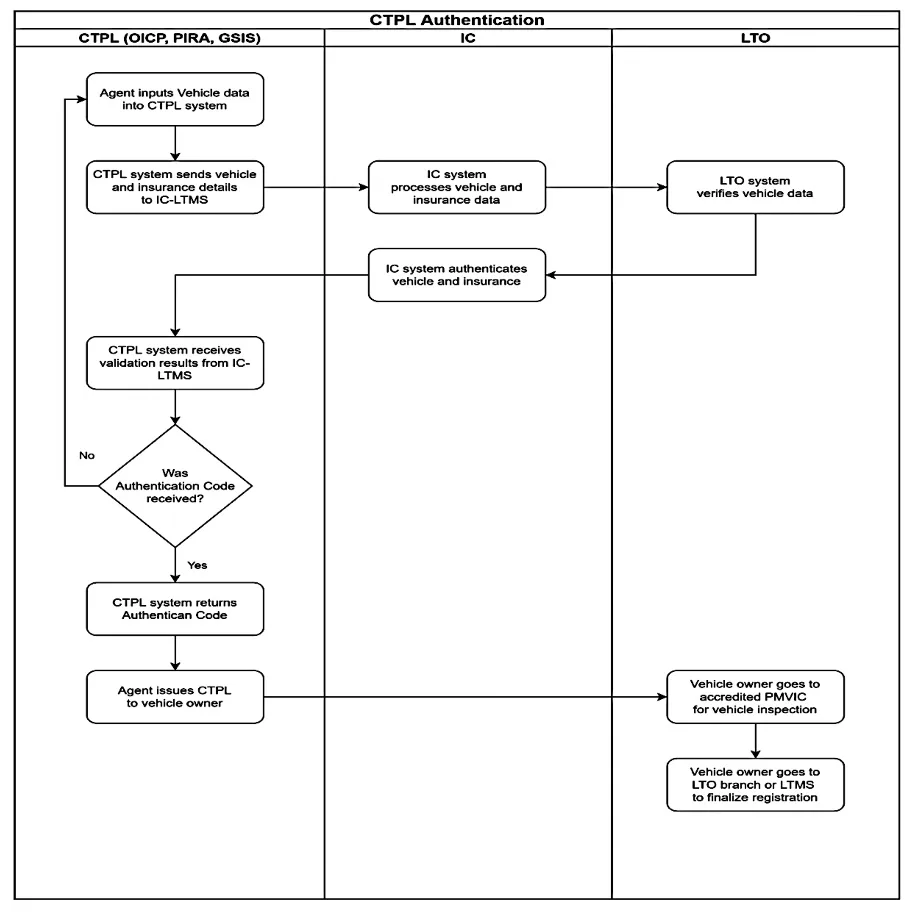
Automobile registration within the Philippines already operates inside an built-in verification framework. Motorized vehicle information is validated by the LTO’s personal Land Transportation Administration System (LTMS) database, whereas Obligatory Third Get together Legal responsibility (CTPL) insurance coverage undergoes a multi-layer authentication course of involving insurers and regulators. These techniques have been constructed exactly to make sure information accuracy and stop pretend insurance policies.
This course of diagram (see above) despatched to me by a dependable supply reveals a completely built-in, closed-loop system the place car information is verified in actual time by the LTO’s personal LTMS database, whereas CTPL insurance policies bear a two-step authentication course of involving insurers and the Insurance coverage Fee. This technique has reportedly functioned successfully for over 15 years with out extra value to the general public.
Towards that backdrop, the introduction of an extra certification layer requires justification that’s each technical and financial.
One other ineffective layer?
From a techniques standpoint, the MV Certification seems to attract from the identical LTMS database that already performs verification. In that case, its position is to not substitute the prevailing course of, however to take a seat on prime of it. That distinction is necessary as a result of if a brand new layer doesn’t materially enhance verification, scale back fraud in measurable phrases, or streamline transactions, then what it introduces is duplication which comes with a value of P60 per transaction. However it doesn’t finish there.
The construction of implementation routes the certification by intermediaries, notably insurance coverage brokers who’re required to safe it as a part of the workflow. In follow, this introduces extra operational burdens — pay as you go voucher mechanisms, administrative dealing with, and processing prices — which are sometimes handed on to motorists. Reviews from market members counsel that the efficient value to the general public can exceed the bottom price as soon as these layers are factored in.
That is how a nominal cost evolves right into a broader financial burden — not by the price alone, however by the system that carries it.
At scale, the arithmetic turns into tough to disregard.
A P60 cost multiplied throughout tens of millions of auto registrations produces a high-volume, recurring income stream. Even permitting for cost-sharing or operational bills, the construction factors to a large monetary pipeline embedded inside a compulsory public transaction. And since car registration is obligatory, the income base is successfully captive.
That is the place the position of DBP-DCI warrants nearer examination.
A evaluation of the construction and working mannequin of DBP-DCI signifies that it isn’t a pure know-how originator however solely as a techniques integrator. It sits on the nexus of the work flowing from the federal government, with its position masking quite a lot of ICT companies — equivalent to techniques growth and outsourcing and consultancy — a scope so broad that in follow usually leans closely on a community of third-party distributors to supply technical finish merchandise.
In that regard, DCI’s position may be thought-about as an middleman: offering entry, consolidating processes, and overseeing transactions between techniques which are working. Does it suggest impropriety? It doesn’t, but it surely raises a proportionality query that’s important to this dialog — whether or not the worth added by this facilitating position is commensurate with the prices launched right into a obligatory public course of.

A matter to be flagged and probed
And that’s the reason the LTO validation controversy is so essential to understanding DBP- DCI. The LTO itself, in February 2026, issued a memo saying the DBP-DCI system was “temporarily held in abeyance,” which signifies the requirement had already turn into contentious sufficient to be suspended.
However nonetheless, the system wanted to be examined as a “proof of idea” the place it needs to be freed from cost. However business stakeholders have been all of a sudden jolted over the P40 after which P60 price within the resumed DBP-DCI validation requirement. These details don’t set up wrongdoing by DBP-DCI. However they do present that its insertion into a compulsory motorist-facing course of triggered sufficient resistance to turn into a coverage subject, not only a back-office IT matter.
There are additionally questions round transparency that deserve consideration.
In well-structured public techniques, charges are clearly disclosed, correctly invoiced, and absolutely auditable. The place assortment mechanisms contain intermediaries, pay as you go devices, or evolving documentation codecs, sustaining readability turns into much more essential. Reviews that invoices should not constantly issued, or that price disclosures have modified over time, underscore the necessity for simple accounting of how funds are collected and reported.
Equally necessary is the coverage framework underpinning the system.
Stakeholders have raised considerations concerning the tempo and method of implementation, together with whether or not enough session and alignment have been achieved previous to rollout. These considerations, if validated, don’t essentially invalidate the system — however they do heighten the necessity for transparency and justification.
It’s because, when a requirement turns into obligatory, the usual is larger.
Motorists don’t select to take part in car registration. They’re compelled. In doing so, they soak up each value embedded within the course of—whether or not or not its profit is straight away seen.
That is the place the difficulty returns to its central rigidity: scale versus worth.
Is the fee justified?
A system that may generate near P1 billion a 12 months can not relaxation on assumption. It should stand on proof — clear, measurable proof that it improves accuracy, reduces fraud, or meaningfully streamlines a course of that already capabilities. With out that, the economics turn into tough to disregard.
When worth is unsure and income is definite, the imbalance just isn’t theoretical — it’s borne every day by the general public.
In that state of affairs, the difficulty is now not a P60 price. It’s the structure of extraction: a construction the place layers are inserted into obligatory processes, the place prices are embedded forward of justification, and the place scale quietly transforms minor fees into main monetary flows.
For establishments just like the LTO, that is the road that separates reform from burden.
Modernization just isn’t outlined by what number of techniques are launched, however by whether or not each earns its place — by decreasing friction, decreasing value, or delivering outcomes that didn’t exist earlier than.
Something much less dangers institutionalizing inefficiency. And inefficiency, as soon as formalized, is way harder to unwind than any legacy drawback it was meant to switch.
In the long run, public belief just isn’t constructed on platforms or processes. It’s constructed on self-discipline — the self-discipline to make sure that each peso collected corresponds to actual, demonstrable worth.
The reason being clear: when that self-discipline falters, the system doesn’t simply get extra advanced, it grows dearer. And the general public, as all the time, shoulders the distinction. – Rappler.com
Click on right here for Rappler tales concerning the LTO’s IT system:
Click on right here for different Vantage Point articles.

https://weblog.passive-income4u.com/create-your-very-own-auto-publish-news-blog-site-and-earn-passive-income-in-just-4-easy-steps/
https://www.rappler.com/voices/thought-leaders/vantage-point-lto-motor-vehicle-certificate-dbp-dci-insurance/