Rising costs and a persistently weaker peso are actively squeezing family budgets throughout the nation, making a quiet however mounting monetary pressure. Alongside these pressures, there’s rising proof of bother with credit-card repayments which raises a troublesome and pressing query: how a lot of at the moment’s client spending can households afford with out compromising their future monetary stability?
A nationwide financial system can simply preserve its outward momentum even when its particular person households are working dangerously wanting money.
Day-to-day, groceries nonetheless attain the kitchen desk, youngsters nonetheless handle to get to highschool, and gas nonetheless goes into non-public and public automobiles for the each day commute.
Nonetheless, when on a regular basis bills outlast the payday cycle, spending continues solely as monetary pressure accumulates behind the scenes. At this time’s retail buy undeniably helps present financial exercise, however the ensuing monetary obligation ruthlessly follows the household into the following month.
When assessing the true well being of the financial system, it pays to look past the standard headline forecasts for Philippine economic growth, inflationand currency valuation.
A much more revealing query is whether or not households earn sufficient to maintain their present spending habits, or whether or not they more and more have to depend on high-interest credit score to bridge the widening hole between their stagnant incomes and escalating each day prices.
Whereas mixture banking figures can’t establish each particular person borrower’s particular grocery or utility purchases, they clearly present when reimbursement troubles start to develop sooner than the credit score supporting these transactions.
Current knowledge from the Bangko Sentral ng Pilipinas (BSP) for common and business banks, as presented by Estella Dhel VillamielFirst Metro Securities division head for institutional analysis, illustrate this development.
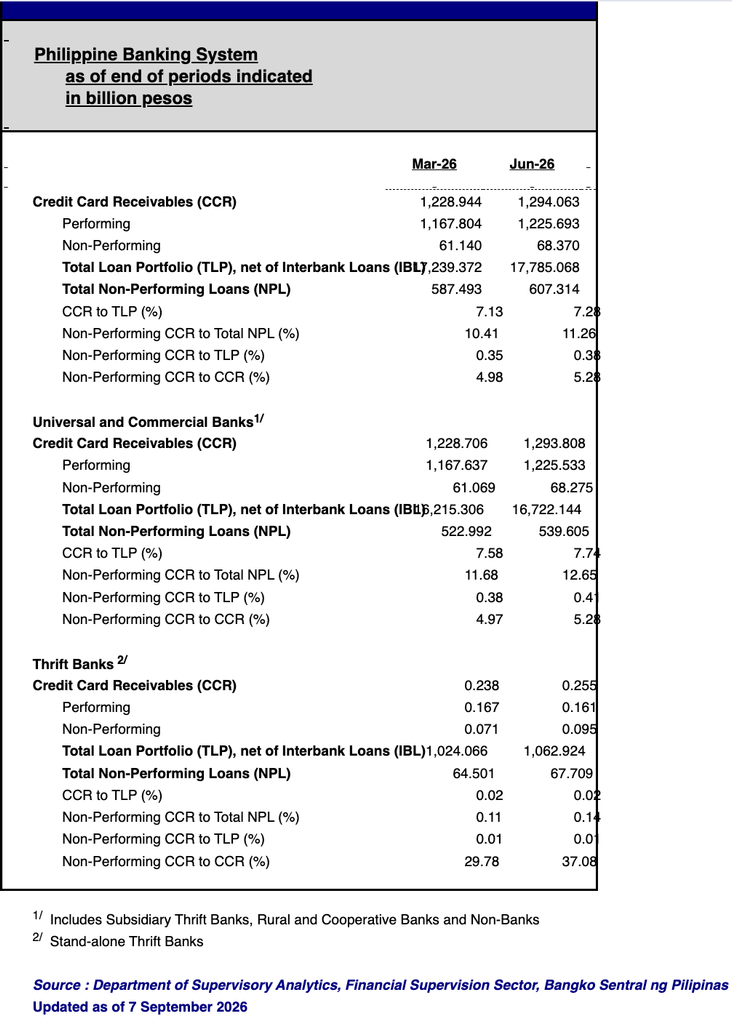
Talking earlier than the bi-monthly discussion board of the Monday Circle Group on the Westin Manila, Villamiel says credit-card receivables reached P1.294 trillion in June, a notable enhance from P1.229 trillion in March.
Over that very same interval, non-performing card receivables—the balances going unpaid—rose from P61.07 billion to P68.28 billion. These quarterly will increase symbolize an total portfolio development of roughly 5.3%, however a a lot steeper 11.8% leap in unhealthy money owed.
As a result of troubled balances grew greater than twice as quick as the general lending portfolio, their whole share was lifted from 4.97% to five.28%. Though these figures symbolize quantities owed quite than absolutely the variety of distressed debtors, the aggressive upward course warrants speedy consideration.
To be clear, this knowledge doesn’t definitively set up a full-blown family debt disaster. Card utilization naturally expands as extra customers enter the formal monetary system, transition away from cash-based transactions, or just make the most of handy cost phrases for routine purchasing.
Moreover, excellent receivables quickly embrace prosperous prospects who reliably settle their statements in full every month. Whereas mixture figures don’t strictly show that households are swiping their playing cards simply to purchase fundamental meals or gas, they set up the defensible and slender discovering that reimbursement stress is noticeably rising inside an increasing credit score portfolio.
The broader financial surroundings makes this refined warning a lot more durable to dismiss. September inflation reached a punishing 7.2%, up considerably from 6.1% in August. Each household’s particular person burden relies upon closely on their particular basket of purchases, however customers with little discretionary cash left after shopping for necessities have far fewer methods to soak up these greater costs.
Every of the choices accessible to them—slicing again on consumption, depleting emergency financial savings, searching for exhausting further work, or borrowing—carries a heavy toll. Borrowing merely shifts that price, with curiosity, into one other month.
World oil costs and the weakening peso compound this strain by means of almost each peculiar transaction. Costly imported gas inevitably raises overhead prices for motorists, transport operators, and logistics companies transferring items throughout the archipelago.
Concurrently, a weaker peso instantly inflates the native price of all dollar-priced imports. Households really feel these relentless pressures by means of rising transport fares, supply fees, and the inflated price of products transported over lengthy distances, even when they don’t personal a automotive or buy imported luxurious objects.
Whereas entry to credit score softens the speedy blow of those worth shocks, carrying a rollover steadiness creates a completely new month-to-month expense. Think about an illustrative P20,000 steadiness charged at a typical 3% for only one month: the curiosity alone could be P600, calculated earlier than every other relevant late charges, fees, and changes.
Precise billing relies on particular card phrases and cost timing, however as soon as curiosity completely enters the family price range, a portion of the following paycheck is robotically hijacked to pay for previous spending quite than placing something new on the household desk.
It could be handy for analysts accountable these reimbursement difficulties fully on careless or financially illiterate debtors. Nonetheless, making that assumption requires concrete proof, in the identical manner that claiming each unpaid steadiness represents real financial hardship does.

A critical examination should rigorously distinguish between frivolous discretionary spending, sudden earnings disruption, and the determined cycle of repeated borrowing. It should additionally acknowledge that cardholders symbolize solely a fraction of the broader inhabitants. Thousands and thousands of households exterior the formal credit score market face extreme financing pressures that banking tables merely can’t seize or measure.
Labor market knowledge replicate this underlying fragility. In August, the nationwide unemployment rate hit 5.3%in comparison with simply 3.9% a yr earlier, whereas underemployment reached 11.9%, up from 10.7%.
Whereas each metrics confirmed slight enhancements from July, they continue to be worse than the earlier yr’s readings. Merely having work and having sufficient work to pay the payments are fully completely different family experiences. The constant availability of ample earnings issues simply as a lot as its baseline buying energy.
Villamiel offered this important macro analysis: The snapshot included forecasts from the DBS Financial institution (previously the Improvement Financial institution of Singapore) projecting inflation to common a painful 6.5% in 2026 and 5.5% in 2027, with the peso closely depreciating to P64 per greenback by the tip of 2027. These sobering projections strongly counsel that family monetary strain might stubbornly persist at the same time as total macroeconomic development improves.
This dynamic is already seen within the nationwide accounts. Family consumption managed to develop by 2.8% within the second quarter, and Gross Domestic Product (GDP) expanded by 2.3%however gross capital formation alarmingly plummeted by 9.2%.
As a result of capital funding is the essential engine that builds the enterprise capability and employment mandatory for future earnings technology, its extreme contraction ought to shift the nationwide financial dialogue properly past merely encouraging customers to spend extra. Debt and credit score can’t indefinitely substitute for the strong financial basis that makes client spending actually reasonably priced.
The BSP now faces a extremely troublesome balancing act. Implementing a agency financial coverage can theoretically include runaway inflation and stabilize foreign money strain, however these tighter financing circumstances weigh closely on each retail debtors and company employers. (READ: (Puso at Diwa) BSP monetary policy: When steady is not really steady)
Moreover, present bank card fees don’t robotically change with each policy-rate adjustment: a decrease BSP rate wouldn’t retroactively erase the crushing balances already collected by households.
Real monetary aid would require devoted consideration to actual incomes, important dwelling prices, and reimbursement capability alongside strict financial stability.
Transferring ahead, business banks should carefully monitor retail affordability and deteriorating accounts with the very same vigilance they apply to portfolio development.
In the meantime, the federal government should aggressively work to revive monetary respiration room by guaranteeing dependable meals provides, constructing environment friendly transport and vitality techniques, encouraging productive capital funding, and strengthening client safety.
Combination client spending can typically look extremely resilient on paper whereas particular person household budgets concurrently turn into dangerously fragile. The last word check of financial well being is whether or not households can comfortably cowl their important wants with out repeatedly carrying yesterday’s bills into tomorrow.
Whereas the upcoming surge in Christmas purchases could quickly supply artificially reassuring indicators of retail exercise, the inevitable credit score statements arriving in January ought to be watched with equal, if not better, curiosity.
True financial restoration signifies that households can reliably meet peculiar bills, systematically repay their money owed, and nonetheless retain one thing for unexpected emergencies.
When the paycheck persistently runs out earlier than payday, securing a better credit score restrict merely postpones the inevitable reckoning. It doesn’t restore the damaged family price range. – Rappler.com
Under are some Vantage Level items you might need missed.
Click on right here for different Vantage Point articles.
https://weblog.passive-income4u.com/create-your-very-own-auto-publish-news-blog-site-and-earn-passive-income-in-just-4-easy-steps/
https://www.rappler.com/voices/thought-leaders/vantage-point-when-paycheck-runs-out-before-payday-credit-card-debt-philippines/