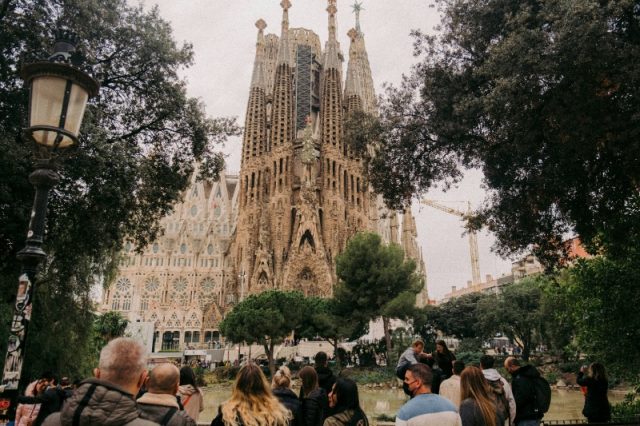
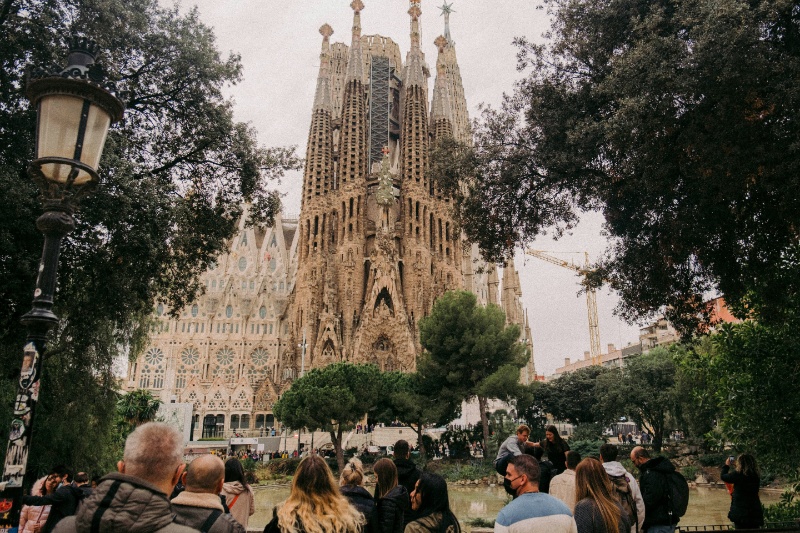
When Pope Leo XIV blessed the Sagrada Família’s tallest, gravity-defying tower on June 10, he took a second to recollect not solely the church’s architect, Antoni Gaudí, but additionally the many individuals – employees and funders alike – who’ve made its ongoing development doable during the last 140 years.
“Along with Gaudí, as we commemorate the centenary of his dying, we bear in mind and provides thanks this night to all of the supporters and benefactors, the artists and the employees who cooperated within the development of an architectural masterpiece, which can also be an eloquent catechesis made from stones, colours and light-weight,” the Pope said in his homily on the Sagrada Família throughout his tour of Spain.
As a enterprise college professor, I’ve written case studies on the Sagrada Família, and repeatedly take college students and govt programme contributors there.
It could seem to be an unlikely place to take enterprise executives: a mammoth, wildly bold challenge whose creator died with only a fraction of labor accomplished, and whose progress has been derailed by a century and a half of Barcelona’s tumultuous historical past, from fires and civil warfare to funding shortages and debate over what to do with a singular endeavor so intimately related to its architect.
Definitely, Gaudí is just not a standard chief, neither is the Família a standard church. But each supply various timeless classes in management, notably in the case of imaginative and prescient, mission and innovation.
Learn how to craft a imaginative and prescient
Gaudí’s imaginative and prescient for Sagrada Família didn’t come to him as a bolt from the blue. It was the product of years of commentary and reflection.
Gaudí took over the Sagrada Família challenge in 1883, inheriting plans to construct a standard neo-Gothic church on the positioning. He initially caught to these plans whereas reconsidering the potential scope and objective of the church.
By the Eighteen Nineties he had envisioned one thing a lot grander: an immense basilica with 18 spires and three monumental façades. Gaudí’s imaginative and prescient advanced constantly over a long time, as he used different architectural tasks as laboratories of concepts that could possibly be put to make use of within the basilica. Over time, his architectural imaginative and prescient – with its distinctive construction, symbolism, geometry and spirituality – turned more and more coherent.
The takeaway right here is that Gaudí imagined boldly and refined patiently, till type and objective aligned. Imaginative and prescient isn’t excellent from the beginning, it’s crafted over time to create significant course.
Making imaginative and prescient resonate
A imaginative and prescient solely positive factors relevance when others can see what you see, when they’re moved to hitch your quest and it turns into their mission as effectively.

The inside construction of the Sagrada Família is deeply unconventional.
Paulo Freitas/Unsplash
Gaudí created many drawings and plaster fashions of his deliberate church, and was adept at speaking in easy language and vivid metaphors. He allowed his colleagues – ironworkers, stoneworkers, ceramicists, a lot of them lifelong collaborators – to work out the main points with out fixed oversight. This meant that when most of the authentic drawings and fashions have been misplaced in a hearth after the architect’s dying, the craftsmen have been capable of recall and restore a lot of the plan and go it on to the following era of architects.
As well as, the Sagrada Família has required huge sums of cash to construct. As an expiatory temple, it depends on particular person alms quite than public funds, and Gaudí understood that he wanted to persuade others of its greatness and encourage them to contribute. He was a tireless fundraiser, even pouring his personal earnings into realising his dream. But the lion’s share of the funds got here from hundreds of particular person donations, making it a piece actually by and for the plenty who had been moved to purchase into Gaudí’s imaginative and prescient.
Gaudí invited individuals, motivated by that means that touches each mind and emotion, to turn out to be companions in a shared mission.
Innovation throughout generations
Throughout Gaudí’s lifetime, sluggish durations within the constructing have been used to take inventory, to dream, and to design new options. After juggling different tasks, he devoted his time completely to constructing the Sagrada Família from 1914 till his dying in 1926.
The basilica is a revolutionary construction in structure which mixes magnificence with mathematical principles. Its improvements embrace a tree-like column system as a substitute of straight pillars, and using catenary arches all through.
Equally essential, Gaudí employed radically progressive varieties, symbolism and the sculptural storytelling of the façades to revive religion and make religious that means accessible and compelling to a society more and more formed by secular modernity.
Whereas Gaudí was exceptionally inventive, each innovation responded to the bigger mission of bringing higher mild, power and concord to his constructions. The lesson Gaudí leaves us: innovation is significant when it serves a higher objective.
The much less apparent chief
Definitely, Gaudí was a special sort of chief. However he exhibits us the worth of broadening our definitions of what a frontrunner can and must be.
In current researchI and my colleagues checked out how leaders emerge in self-directed groups. This setting is revealing as a result of it permits us to see how leaders emerge naturally, quite than being appointed from above.
We discovered that in newly fashioned groups, assured and leadership-seeking individuals are those who sometimes emerge as leaders. However probably the most assertive individual will not be the one good chief in the long run. This additionally raises the query of what motivates an individual to steer within the first place.
In a brand new crew, the will to steer is usually decided by an individual’s identification with a management position and their intrinsic need to steer. Nonetheless, different leaders are pushed by a special, extra communal motive that views management as an obligation or service to others.
These people are much less involved with the self and extra with group. Their traits – together with constructing belief, collaboration and empathy – don’t place them front-and-centre in a brand new crew, however they do come to matter extra as a crew matures. They’re related to heat and, as our research discovered, with competence.
As a frontrunner, Gaudí undoubtedly falls into this second, extra delicate class. These traits have been all evident within the imaginative and prescient, planning and work he displayed throughout his life. However right now, 100 years after his dying, they nonetheless information the Sagrada Família development crew – which is itself 140 years outdated, and counting.
Yih-Teen LeeProfessor, IESE Business School (University of Navarra)
This text is republished from The Conversation underneath a Inventive Commons license. Learn the original article.
https://weblog.passive-income4u.com/create-your-very-own-auto-publish-news-blog-site-and-earn-passive-income-in-just-4-easy-steps/
https://interaksyon.philstar.com/trends-spotlights/2026/07/23/316780/what-gaudi-and-the-sagrada-familia-can-teach-us-about-leadership/